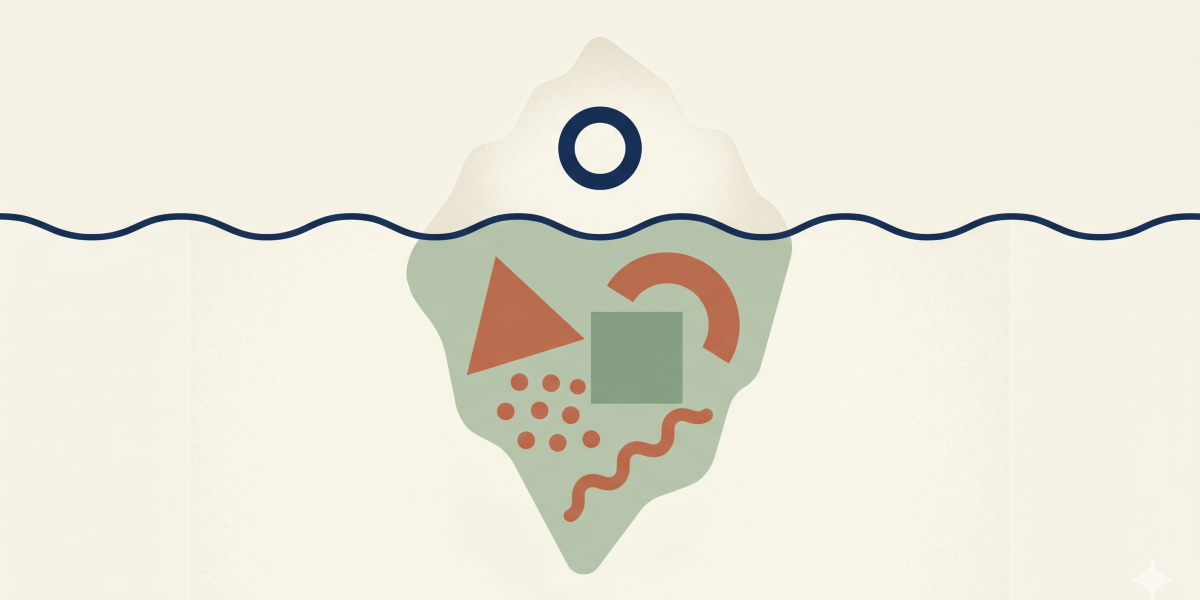
When most founders think about brand identity, they think about their logo. Maybe their color palette. Maybe a tagline if they’re feeling generous.
That’s a problem.
Because if your logo disappeared tomorrow, your real brand — the one that lives in customers’ heads — should still be intact. The companies that get this right (Apple, Liquid Death, Patagonia, Mailchimp) didn’t win by designing prettier logos. They won by building brand assets that customers can feel even when no logo is visible.
At Scale Base Media, we’ve audited the brand identity of more than 50 businesses. The pattern is brutally consistent: the logo is the part founders agonize over, and the invisible assets are where the money is actually left on the table.
Here are the five invisible brand assets that drive recognition, trust, and loyalty — and how to start building yours.
What Is a Brand, Really?
Before we talk about assets, let’s settle the definition. A brand is not a logo, a name, or a color. A brand is the set of associations that fire in a customer’s brain when they encounter you — or even just think about you.
Marty Neumeier put it best: “A brand is a person’s gut feeling about a product, service, or company.”
Your logo helps trigger those associations. But the associations themselves are built somewhere else — in the five invisible layers below.
Asset #1: Brand Voice (How You Sound)
Your brand voice is how your company speaks — in emails, on your website, in ads, in customer support, on social. If you stripped your logo off and just showed someone a paragraph of copy, would they recognize it as you?
For most businesses, the answer is no. Most company copy sounds like every other company in the category.
A strong brand voice has three things:
- A distinctive vocabulary. Words you use, words you don’t. Liquid Death says “murder your thirst.” Mailchimp says “high fives.” These aren’t accidents.
- A consistent rhythm. Short sentences or long? Conversational or formal? Punchy or contemplative?
- A clear emotional register. Confident, playful, irreverent, technical, warm — pick one and commit.
How to build it: Write a one-page voice guide. List 10 phrases your brand would say, and 10 it would never say. Audit your last five emails and ads against that list.
Asset #2: Visual System (Beyond the Logo)
Your visual system is everything that lives alongside your logo: your color palette, typography, photography style, iconography, illustration approach, and layout principles.
The test: can a customer recognize a piece of content as yours with the logo removed?
If you scroll through Apple’s Instagram with the handle hidden, you still know it’s Apple. The negative space, the off-white background, the typography — the system is unmistakable. That’s a brand asset doing real work.
Most small businesses have a logo and “kind of” matching colors. The fix:
- Pick a primary color, secondary color, and accent color — and use them in roughly the same ratio every time.
- Pick two fonts max (one for headlines, one for body) and use them everywhere.
- Define a photography style — bright and airy? Moody and contrasty? Documentary? Set the rules and don’t break them.
Asset #3: Behavioral Signature (How You Act)
This one gets ignored by 95% of brands, and it’s arguably the most powerful.
Your behavioral signature is the set of things your brand consistently does that competitors don’t. It’s the actions that, when customers experience them, make them say “that’s so them.”
Examples:
- Zappos famously sends flowers to customers going through a hard time.
- Patagonia ran a “Don’t Buy This Jacket” ad on Black Friday.
- Trader Joe’s writes hand-lettered signs in every store.
These behaviors compound. Every time a customer experiences one, the brand gets stronger — without anyone seeing a logo.
How to build it: Pick one behavior you can do consistently that no competitor would do. A handwritten thank-you card on every order over $X. A free 15-minute consult with the founder. A surprise upgrade after 6 months. Something. Then do it every single time.
Asset #4: Point of View (What You Believe)
Brands that last have a point of view on the world — not just a product to sell.
Notion believes software should be flexible, not opinionated. Basecamp believes meetings are toxic and remote work is the future. Liquid Death believes the beverage industry is a joke and is here to make fun of it.
These aren’t marketing positions. They’re worldviews. And customers buy into worldviews far more deeply than they buy into features.
If someone asked your business “what do you believe about your industry that most competitors get wrong?” — could you answer in one sentence?
If not, that’s your homework. Because that sentence becomes the seed of everything else: your content, your sales pitch, your hiring, your product roadmap.
Asset #5: Sonic & Sensory Cues (How You Feel)
The most underused brand asset in 2026: sound, motion, and texture.
- Netflix’s “ta-dum” sound logo is recognized by 95% of subscribers in under two seconds.
- McDonald’s “I’m lovin’ it” jingle is a five-note brand asset worth billions.
- Mailchimp’s playful motion language (the wiggle, the bounce) is instantly recognizable.
You don’t need a Hollywood budget. You need consistency. Pick:
- A sonic cue — a short jingle, a sound effect for your video intros, a podcast theme.
- A motion language — how things animate on your website (smooth, bouncy, snappy, sliding).
- A tactile feel if you ship physical products — packaging weight, paper texture, unboxing ritual.
Each of these creates a memory hook that fires before a customer consciously identifies your logo.
How to Audit Your Own Brand Identity in 30 Minutes
Run this audit on your business today:
- Voice test: Copy three paragraphs from your website. Paste them into a doc next to three competitor paragraphs. Could a stranger tell which is yours?
- Visual test: Screenshot three social posts. Cover the logo. Are they still recognizable as yours?
- Behavior test: What’s one thing your brand does that a customer would tell their friend about?
- POV test: Write one sentence that begins “We believe…” — does it differentiate you?
- Sensory test: What does your brand sound or feel like? If you can’t answer, you have work to do.
A weak score on any one of these is a multi-million-dollar gap, depending on how big you want to grow.
Frequently Asked Questions
What’s the difference between a logo and a brand identity? A logo is a single visual mark. A brand identity is the complete system that includes your voice, visual style, behavior, point of view, and sensory cues — everything that creates recognition and emotion in customers’ minds.
How long does it take to build a strong brand identity? Foundational brand identity work (voice, visual system, positioning) takes 4 to 8 weeks with an experienced team. But brand equity — the trust and recognition customers build with you — compounds over years of consistent execution.
Do small businesses really need a brand strategy? Yes. In fact, small businesses need brand strategy more than enterprises because they can’t outspend competitors. A clear identity is the highest-leverage way to win attention and trust without a Coca-Cola-sized ad budget.
How much should a small business invest in branding? A solid foundational brand identity package — strategy, voice, visual system, and brand guidelines — typically ranges from $5,000 to $25,000 depending on scope. Anything cheaper usually skips strategy. Anything more expensive at your stage is overkill.
Ready to Build a Brand That Doesn’t Need Its Logo to Be Recognized?
Most agencies will sell you a logo. We build the full identity system — voice, visuals, behavior, POV, and sensory cues — so your business gets recognized, trusted, and remembered.
Get a free brand audit — we’ll show you exactly which of the five assets you’re missing and what it’s costing you.